What is Clay Pigeon Shooting?
Clay pigeon shooting is a sport where participants use shotguns to fire at disc-shaped targets (known as "clays" or "birds") launched from mechanical devices called traps. The sport originated in the 18th century as a substitute for live pigeon shooting and has since grown into one of the most popular shooting sports in the United Kingdom.
Clays are launched at various speeds, angles, and distances to simulate the flight paths of game birds. The sport is enjoyed both as a competitive discipline -- with events ranging from local club shoots right through to the Olympic Games -- and as a leisure activity suitable for a wide range of ages, fitness levels, and experience.
One of the great appeals of clay shooting is its accessibility. You do not need to own a gun or have any previous experience to try it; most shooting grounds across the UK offer "have-a-go" sessions where everything is provided and expert instruction is included.
Types of Disciplines
Clay pigeon shooting encompasses several distinct disciplines, each governed by the Clay Pigeon Shooting Association (CPSA) in England. Here are the main formats you will encounter:
English Sporting
Simulates game shooting with varied targets including crossing, driven, quartering, rabbits, and more. The most popular discipline in the UK.
Skeet
Targets launched from two fixed trap houses (high and low) on a semicircular layout. Variants include English Skeet and Olympic Skeet.
Trap (Down-the-Line)
Targets launched away from the shooter at varying angles. DTL is the most common trap format, alongside Automatic Ball Trap and Olympic Trap.
FITASC Sporting
An international sporting format with more restrictive rules on gun mounting, offering a tougher challenge for experienced shooters.
Compak Sporting
A compact form of sporting shot on a smaller layout, ideal for grounds with limited space.
Equipment You Will Need
Shotgun
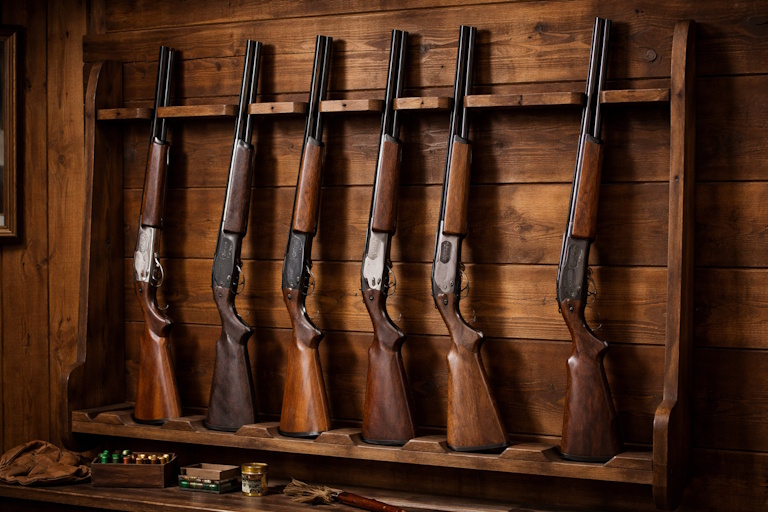
The over-and-under is the most common shotgun type for clay shooting in the UK. Side-by-sides are used but less typical for competition, while semi-automatics are permitted in some disciplines. The standard gauge is 12-bore; 20-bore is a lighter alternative suitable for beginners or younger shooters. For your first session, the shooting ground will provide a gun for you.
Cartridges
Standard clay cartridges are 12-gauge, typically 28g or 24g load with shot sizes 7, 7.5, or 8. Lead shot restrictions are evolving in the UK, and steel and bismuth alternatives are becoming increasingly common. Cartridges are usually included in beginner sessions or available to purchase at the ground.
Eye Protection
Shooting glasses with clear or tinted lenses. Yellow or orange lenses are ideal for overcast days; darker lenses for bright conditions.
Ear Protection
Ear defenders (passive or electronic) or foam ear plugs are essential. Hearing damage from gunfire is cumulative and permanent.
Clothing tip: Wear comfortable outdoor clothing suitable for the weather. A shooting vest with cartridge pockets and a padded shoulder is useful but not essential for your first visit. Avoid loose scarves or open-necked shirts that could catch hot cartridge cases.
Shotgun Certificates & Legal Requirements
You do NOT need a shotgun certificate to try clay shooting for the first time. Shooting grounds can provide guns under supervised conditions under Section 11(6) of the Firearms Act 1968.
To own a shotgun in the UK, you need a Shotgun Certificate (SGC) issued by your local police force. The application involves completing form 201, providing a countersignatory, undergoing a police interview, and a home visit to inspect your gun storage (a secure gun cabinet bolted to a wall or floor).
Age requirements: Under-15s can use a shotgun under the direct supervision of a certificate holder. Those aged 15-17 can be given a shotgun as a gift but cannot purchase one. From age 18, you can apply for your own SGC.
Check with your police force for the current fee for a new Shotgun Certificate it is valid for five years. CPSA membership is required for most competitions and provides third-party liability insurance.
Choosing a Shooting Ground
Look for a CPSA-registered ground that offers "have-a-go" or taster sessions specifically designed for beginners, where guns, ammunition, ear protection, and instruction are all provided. Check what disciplines the ground offers and look for grounds with qualified instructors (CPSA or APSI accredited coaches).
Our Club & Ground Directory lists shooting grounds across the UK, complete with the disciplines they offer and visitor information.
Your First Visit
On arrival, you will register at reception and receive a comprehensive safety briefing. Your instructor will explain the gun -- how to load, unload, carry it safely, and how the safety catch operates. They will cover range commands and etiquette before you head out to the stands.
You will start with straightforward targets, typically a going-away bird or a gentle crossing clay. A typical taster session lasts one to two hours and includes around 25 to 50 cartridges.
Do not be discouraged if you miss -- it takes time to develop the hand-eye coordination needed to consistently break clays. Most beginners start hitting targets within their first few shots with proper instruction.
Basic Shooting Technique
Stance
Stand with your feet roughly shoulder-width apart, weight slightly forward on the front foot, body angled about 45 degrees to the target line.
Gun Mount
Bring the stock smoothly to your cheek and shoulder in one fluid movement. The comb of the stock should rest firmly on your cheekbone, and the butt should sit in the pocket of your shoulder.
Eye Dominance
It is critical to establish whether you are right-eye or left-eye dominant. If your dominant eye does not match your dominant hand, your instructor will advise on solutions such as shooting from the other shoulder, closing one eye, or using an occluder patch.
Leading the Target (Forward Allowance)
Clay targets are moving, so you must shoot ahead of them. The three main methods are:
- Swing through: Start behind the target, swing through it, and pull the trigger as you pass ahead.
- Maintained lead: Match the target's speed with a consistent gap ahead and fire while maintaining the lead.
- Pull away: Mount on the target, accelerate past it, and fire.
Follow through is essential -- continue the gun's movement after pulling the trigger. Stopping the swing is one of the most common reasons for missing behind the target. When you are ready, call "Pull!" clearly to request the target.
Safety Rules & Etiquette
Safety is paramount in any shooting sport. These rules must be followed at all times on any shooting ground:
Always treat a gun as if it is loaded.
Never point a gun at anything you do not intend to shoot.
Keep the gun broken or with the action open when not on the stand.
Only load when on the stand and instructed to do so.
Only close the gun when it is pointing down range.
If a misfire occurs, keep the gun pointed down range for at least 30 seconds.
Listen to and follow all instructions from the referee or instructor.
Do not consume alcohol before or during shooting.
Gun Fit & Choke
Gun Fit
The dimensions of the stock (length of pull, drop at comb, drop at heel, and cast) determine how well the gun points where you look. Poor gun fit is one of the most common causes of persistent missing. As you progress, consider having a professional fitting to ensure your gun suits you.
Choke
Choke is the constriction at the muzzle end of the barrel that controls how tightly the shot pattern spreads. Common designations include Cylinder, Improved Cylinder (1/4), Modified (1/2), Improved Modified (3/4), and Full. Beginners typically shoot with 1/4 and 1/2 choke. Many modern shotguns have interchangeable multi-choke systems.
Progressing in the Sport
Once you have caught the clay shooting bug, there are many ways to develop your skills and involvement in the sport:
- Join a local club -- the CPSA website has a club finder, and our directory can help you find grounds near you.
- Enter club-level competitions to gain experience in a friendly, supportive environment.
- Invest in regular coaching to develop technique and fix bad habits early on.
- Track your progress through the CPSA classification system (classes AA, A, B, C, and unclassified).
- Aim higher -- national and international competitions such as the English Open, British Open, and World Championships are all within reach.
Costs Involved
| Taster session (inc. gun hire & cartridges) | £30 - £60 |
| Cartridges (per box of 25) | £5 - £8 |
| Clay targets | £6 to £8 per 25 targets |
| Entry-level over-and-under shotgun | £500 - £800 |
| Mid-range shotgun (Beretta, Browning, Miroku) | £1,000 - £3,000 |
| High-end shotgun (Perazzi, Krieghoff, Blaser) | £5,000+ |
| Gun cabinet | £100 - £250 |
| CPSA annual membership | ~£80 / year |
| Shotgun Certificate (new grant, 5-year) | Check with your police force |